

What Is Agentic-Driven Delivery (ADD) and Why It Will Replace Traditional SDLC?
%20and%20Why%20It%20Will%20Replace%20Traditional%20SDLC/What%20Is%20Agentic-Driven%20Delivery%20(ADD)%20and%20Why%20It%20Will%20Replace%20Traditional%20SDLC%202%20main%20img.avif)
Did you ever imagine that an intelligent system could design, build, test, and improve itself without waiting for human input? Yes, this is happening now with the advent of Agentic AI that is transforming the Software Development Life Cycle (SDLC), turning every phase into an intelligent, autonomous process.
AI agents in software development are redefining tasks not merely for assisting but for collaborative work. The application of Agentic AI in SDLC performs autonomous, goal-oriented tasks, making complex decisions and intelligently responding to situations based on contextual knowledge and adapting to the data fed into it. This is the foundation of what the industry now calls Agentic-Driven Delivery (ADD), an AI-native SDLC model built around autonomous software development rather than human-led, sequential execution.
According to Gartner, 40% of enterprise applications will embed task-specific AI agents by the end of 2026, up from less than 5% in 2025. The shift is already happening, and the organizations leading it are redefining what efficiency, reliability, and compliance mean in a digital-first world.
In this blog, we will examine what AI agents are, their role in the software development life cycle, and how agentic software delivery automates and transforms each SDLC phase, and why AI-driven software delivery is on track to replace the traditional model altogether.
Why Traditional SDLC Is Failing Enterprises
The traditional SDLC was designed for a world of human-led, sequential execution. Business teams define needs. Product teams translate them into requirements. Engineering interprets those requirements. QA validates the output weeks later. DevOps prepares the release. Security and compliance review near the end, when changes are most expensive.
Every handoff creates friction. Requirements drift between teams. Context gets lost in translation. QA surfaces problems too late to fix cheaply. Engineering capacity bleeds into rework instead of new value creation.
This structural fragility is now well documented. Deloitte's 2026 Tech Trends research is direct about the scale of the mismatch: infrastructure built for cloud-first strategies cannot handle AI economics, processes designed for human workers do not work for agents, and IT operating models built for service delivery do not drive business transformation. Deloitte frames this not as an enhancement problem but a rebuilding problem.
The data on AI coding assistants alone makes the case. 2026 Software Industry Outlook notes by Deloitte that AI could potentially drive productivity gains of 30% to 35% across the SDLC, but only for organizations that integrate agentic AI capabilities across the full lifecycle, including requirements development, coding, testing, deployment, and monitoring, rather than just the coding phase. Point tools that only touch code generation capture a fraction of that value.
This is the gap that enterprise SDLC transformation must close, and it is the exact gap that Agentic-Driven Delivery is built to solve.
From Automation to Intelligence: The Agentic Shift
Modern DevOps pipelines are highly automated, but still fundamentally human-governed. Code reviews, compliance checks, and validation gates depend on manual oversight, slowing down releases and creating blind spots in quality and security.
Enter agentic AI, autonomous reasoning systems that understand context, learn from experience, and act intelligently across the software delivery chain. These systems go beyond static scripts or playbooks. They reason, predict, and self-correct.
Imagine pipelines that:
- Validate code quality and standards in real time
- Optimize build workflows autonomously
- Predict deployment failures before they happen
- Enforce compliance without human intervention
According to McKinsey, enterprises embedding AI into software development see 20-30% faster delivery, 40% fewer defects, and 25% greater release predictability. This leap isn't powered by automation, it's driven by intelligence.
Software delivery is no longer a process you manage; it's a system that manages itself.
This is precisely the distinction that separates intelligent development lifecycle models from the automation enterprises have already tried. Automation executes fixed instructions. Agentic AI reasons, adapts, and improves, which is why how Agentic-Driven Delivery works is fundamentally different from scripting a pipeline.
What Is Agentic-Driven Delivery (ADD)?
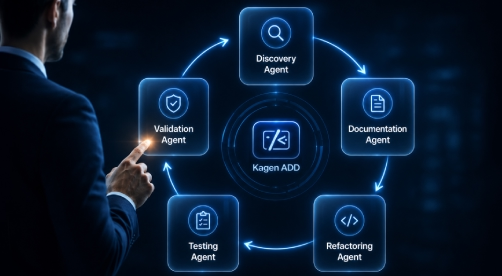
Agentic-Driven Delivery is an AI-native software delivery platform model in which autonomous AI agents plan, build, validate, and ship software across the entire SDLC, from business intent to production deployment, while humans retain control over the decisions that matter.
Unlike AI coding assistants, which begin where the developer begins (inside the IDE, terminal, or repository), ADD begins earlier, with business requirements, and extends further, into QA, governance, and release readiness. This is the core distinction in any conversation about agentic-driven delivery vs traditional SDLC: traditional models treat AI as a feature added to existing workflows, while agentic driven delivery treats AI as the operating model itself.
Deloitte's research on the future of software engineering captures this shift precisely: agents are not meant to be simple assistant overlays on human workflows. Organizations can deploy agents as autonomous actors embedded directly into the software development life cycle, agents that reason, plan, execute, and learn across product and engineering domains, acting as co-creators, force multipliers, and self-evolving platforms.
Deloitte goes further, describing the broader industry transition as a shift from a software development life cycle to an agent-orchestrated development life cycle (AO-DLC), a reshaping of how work flows, how teams collaborate, and how quality is governed.
This is the architecture behind autonomous SDLC for enterprises: a model where multi-agent systems for software development replace single-path, single-developer execution with parallel, competing, self-validating delivery.
How Agentic-Driven Delivery Transforms Every SDLC Phase
Spec: Where Requirements Become Intelligence
In traditional delivery, weak requirements are the single most expensive failure point. Acceptance criteria are vague. Business rules live in someone's head or buried in legacy documentation. Engineering interprets the same brief differently than product intended, and QA discovers the gap only in UAT, when it is most expensive to fix.
In AI-driven engineering workflows, the spec phase becomes intelligent rather than administrative. AI agents convert a rough idea, ticket, PRD, design, or legacy codebase into a structured specification, complete with expected outcomes, constraints, and acceptance criteria, before a single line of code is written.
Plan: Coordinated Execution, Not Sequential Guessing
Enterprise software touches APIs, databases, compliance rules, third-party integrations, and infrastructure simultaneously. Traditional planning hands this complexity to developers to untangle as they go.
Under agentic AI for software development, planning agents map dependencies, decompose tasks, and structure execution paths before build begins, giving every team a shared, unambiguous view of what is being built and how it touches the rest of the system.
Build: Multi-Agent Execution Over Single-Path Development
This is where the agentic model diverges most sharply from both traditional development and single-agent AI coding assistants.
Rather than one developer or one AI agent producing a single first draft, multi-agent systems for software development deploy competing agents that explore different implementation approaches in parallel, compare outputs, and converge on the strongest result. This is the practical expression of what Deloitte describes as agents acting as force multipliers across the engineering domain, agentic engineering collapses the constraints that limited traditional greenfield development to human throughput: ideation cycles, backlog refinement, and manual experimentation.
QA: Validation Built Into the Pipeline, Not Bolted on After
AI-generated code without rigorous validation creates real enterprise risk. Industry research has repeatedly flagged that organizations deploying AI-generated code without adequate testing expose themselves to compliance, security, and rework costs that erode the very productivity gains AI was meant to deliver.
In an agentic pipeline, QA is not a final gate, it is continuous. Agents validate acceptance criteria, test outputs, and trigger automated fix-and-revalidate loops the moment an issue surfaces, long before it reaches a human reviewer.
Deploy: Release Readiness as Part of the Build
Enterprise delivery does not end when code compiles. Pull requests need preparation. Changelogs need generation. Compliance and security teams need evidence of what was tested and approved.
Under Agentic-Driven Delivery, this final mile is part of the same intelligent loop, agents generate release-ready artifacts alongside the build itself, rather than leaving DevOps to assemble them under deadline pressure.
Also read: Common Myths About Conversational AI Voice Agents and What’s Actually True
Why Agentic-Driven Delivery Will Replace Traditional SDLC
The evidence for this shift is no longer speculative, it is showing up consistently across the research from the industry's most credible analyst firms.
- The adoption curve is the steepest in a decade. According to Gartner's Q1 2026 survey data, 80% of enterprise applications shipped or updated now embed at least one AI agent, up from just 33% in 2024. Gartner's own researchers describe this two-year jump as steeper than any comparable enterprise software adoption curve since cloud computing in 2010–2012.
- Production deployment, not just piloting, is accelerating. S&P Global Market Intelligence and McKinsey research found that 31% of enterprises already have at least one AI agent in production, with banking and insurance leading at 47%.
- The return on investment is measurable and fast. BCG and Forrester's 2026 survey data puts the median time-to-value on agent deployments at 5.1 months across functions.
- The role of the developer is shifting from execution to orchestration. As Gartner's Anushree Verma put it, AI agents will evolve from task- and application-specific agents into agentic ecosystems, transforming enterprise applications from tools supporting individual productivity into platforms enabling autonomous collaboration and dynamic workflow orchestration.
This is precisely why the conversation around the future of enterprise software delivery has moved past "should we adopt AI coding tools" and into "how do we redesign the SDLC around autonomous agents." The enterprises asking the second question are the ones McKinsey, Gartner, and Deloitte all point to as the early leaders in this transition.
The Governance Gap: Why Most Agentic AI Projects Still Fail
It would be incomplete, and dishonest, to present Agentic-Driven Delivery as a guaranteed win without acknowledging the real risk enterprises face in adopting it carelessly.
Gartner forecasts that more than 40% of agentic AI projects will fail by 2027, not because the technology does not work, but because organizations are automating existing, human-centric processes instead of reimagining workflows for an agent-native environment. Deloitte's research reaches a similar conclusion: only 14% of organizations have deployable agentic solutions today, and just 11% are actively running them in production, despite widespread experimentation.
The common failure pattern across this research is consistent: enterprises treat agentic AI as a bolt-on automation layer rather than rebuilding the operating model around it. Deloitte's State of AI in the Enterprise research reinforces why this matters, agentic AI usage is poised to rise sharply over the next two years, but oversight is lagging badly behind adoption, with only one in five companies reporting a mature governance model for autonomous AI.
This is the single most important distinction enterprises need to understand before adopting enterprise agentic AI: governance is not a constraint on autonomous delivery, it is the precondition for it working at all. A platform without human-in-the-loop approval gates, a full audit trail, and compliance-first architecture is not a safer or simpler version of Agentic-Driven Delivery. It is a different, riskier category of tool entirely.
Benefits of Agentic-Driven Delivery for the Enterprise
When implemented with proper governance, the benefits of Agentic-Driven Delivery compound across every dimension of enterprise software delivery:
- Faster delivery cycles. Multi-agent execution running in parallel, rather than sequential, single-path development, compresses delivery timelines that traditional models cannot match.
- Lower QA and rework costs. Continuous, built-in validation catches defects before they reach late-stage review, where fixing them is most expensive.
- Stronger compliance and auditability. Every agent action, decision, and validation step is logged and traceable, giving security and compliance teams the evidence they need without slowing delivery.
- Reduced dependency on tribal knowledge. Persistent enterprise context means institutional knowledge is captured in the system rather than walking out the door when a senior engineer leaves.
- Predictable AI economics. Intelligent model routing ensures the right level of reasoning runs on the right task, avoiding the unmanaged token spend that has made many enterprise AI pilots difficult to scale financially.
- A genuine shift in human focus. As Deloitte's research on the unconstrained AI era notes, the result of agentic engineering is not simply faster coding, it is faster learning and speed to insight, freeing engineering teams to move from linear delivery to continuous exploration.
Implementing Agentic AI in Software Development: What Enterprises Need to Get Right
For enterprises evaluating how to move from pilot to production, the research points to a consistent set of priorities:
Build governance into the model from day one rather than retrofitting it after deployment. Choose platforms with persistent enterprise context rather than session-based tools that start cold every time. Demand full audit trails as a non-negotiable requirement, not an optional add-on. Insist on LLM-agnostic architecture so delivery capability never depends on a single model provider's roadmap. And treat the SDLC as a system to be redesigned, not a set of tasks to be automated piecemeal.
Deloitte's framing of this moment is worth sitting with: every enterprise will be affected by this shift, and the organizations that move deliberately in the next 12 months will likely set the terms, while the rest spend the following years adapting to standards set by others.
The Future of Enterprise Software Delivery Is Already Here
The traditional SDLC was built for a world where software delivery was constrained by human throughput, by how fast a team could write, review, test, and ship code in sequence. That constraint no longer holds.
Agentic-Driven Delivery represents the next-generation SDLC: a model where autonomous AI agents handle planning, build execution, QA validation, and release readiness as one continuous, governed system, not as a collection of point tools stitched together with human glue.
The research from Gartner, McKinsey, and Deloitte converges on the same conclusion from different angles: the shift is not optional, the window to lead it is measured in months, and the enterprises that rebuild their delivery model around agentic AI, with the governance to do it safely, will set the competitive standard the rest of the industry has to follow.
The question for every engineering and technology leader is no longer whether Agentic-Driven Delivery will replace the traditional SDLC. It is how quickly your organization can adopt it, govern it properly, and turn it into a durable advantage before your competitors do.
Also read: Compressing Enterprise AI Delivery from 8 Months to 6 Weeks
Ready to See Agentic-Driven Delivery in Action?
The future of software delivery isn't just automated, it's agentic. As enterprises face increasing pressure to deliver faster, improve quality, and maintain compliance, traditional SDLC approaches are becoming harder to scale. Agentic-Driven Delivery (ADD) brings intelligence, autonomy, and continuous optimization into every stage of the software lifecycle, enabling teams to move from managing delivery to accelerating innovation.
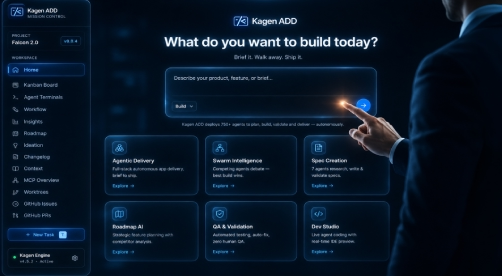
Kagen ADD (Agentic-Driven Delivery) helps enterprises build an AI-native software delivery ecosystem where intelligent agents automate workflows, enhance decision-making, and drive faster, more reliable releases. Ready to move beyond traditional SDLC? Discover how Kagen ADD can transform your software delivery journey, connect with us today.