

AI-Enabled Enterprise Document Management: Transforming Workflows and Elevating Security
Modern enterprises generate and handle millions of documents – contracts, invoices, policies, technical manuals – and the way these are managed can make or break productivity and compliance.

Introduction
Modern enterprises generate and handle millions of documents contracts, invoices, policies, technical manuals and the way these are managed can make or break productivity and compliance. Gone are the days when a Document Management System (DMS) was just a digital filing cabinet. Today, AI-enabled DMS platforms are becoming critical infrastructure, turning document repositories into intelligent engines that understand content, automate workflows, and proactively protect sensitive data. As Adobe notes, AI is evolving document management “from a basic storage system into an intelligent tool that can understand, organize, and automate your document processes”. This blog post explores how AI-driven features are transforming enterprise document workflows, why robust security and privacy are paramount in modern DMS solutions, and how Kagen.ai’s Enterprise DMS provides a comprehensive, AI-native platform for these needs. We’ll also compare AI-native DMS platforms to legacy systems to highlight the strategic advantages in intelligence, automation, compliance, and security responsiveness.
AI-Driven Features Transforming Enterprise Workflows
Enterprise CTOs and IT leaders are leveraging a new wave of AI-powered DMS features to boost productivity and unlock value from their organization’s documents. Key AI-driven capabilities include:
- Automated Document Summarization: Advanced AI models can rapidly read lengthy documents and generate concise summaries or extract key insights. Instead of manually skimming a 50-page report, users can get an instant overview of the main points and action items. Emerging AI summarization even “distills contracts, reports, and proposals into digestible overviews” and highlights key takeaways. This not only saves time but ensures nothing important is missed in dense documentation.
- Intelligent Tagging & Classification: Machine learning (ML) algorithms automatically classify documents by type or topic and apply metadata tags without human intervention. AI-powered systems can OCR scan and interpret documents, then tag and route them appropriately, reducing manual filing errors. For example, an AI DMS can recognize an incoming HR form vs. a legal contract and file each in the correct category. This intelligent auto-tagging means documents are organized consistently and can be found via relevant terms later. Over time, the system learns from new documents and user behavior, continuously improving its classification accuracy.
- Semantic & Vector-Based Search: Unlike traditional keyword search, AI-driven semantic search understands the meaning behind queries and finds contextually relevant content, not just exact keyword matches. It uses vector embeddings – mathematical representations of document content – to retrieve documents that are semantically similar to a query, even if they don’t contain the same keywords. This allows users to search in natural language (“find the policy about remote work security”) and get precise results. As Cisco describes, “users enjoy support for natural language queries,” and the engine “matches results based on the meaning and context of the queries, rather than just keywords”, yielding more accurate answers. In practice, semantic search powered by AI can interpret intent and synonyms – searching for “CEO contract” might also surface “executive agreement” if it’s relevant. This dramatically improves findability of information. In fact, organizations using AI assistants have seen document search times drop by as much as 70%, and employees can retrieve information in seconds rather than hours.
- Document Word Clouds & Visual Analytics: AI-enabled DMS platforms often provide visual text analysis tools – for instance, word clouds or topic maps generated from a document or a set of documents. A word cloud quickly highlights the most frequent terms in a document, giving a snapshot of its key themes. This helps users and decision-makers visually interpret text and quickly gain insight into the most prominent topics without reading everything line by line. Visual analytics dashboards can show trends like which document categories are most active, content overlaps between departments, or sentiment analysis of document text. These AI-driven visualizations enable faster analysis and informed decisions by presenting complex textual data in an accessible, at-a-glance format.
- Multi-User Document Chat: A recent innovation is the ability for multiple team members to interact with an AI assistant collaboratively in the context of their documents. Imagine a group of analysts all in a chat with an AI agent that has access to their document repository – one user asks a question about last quarter’s sales contracts, another follows up with a related query, and the AI provides answers drawing from the relevant documents. This “many-to-one” collaborative chat with an AI not only democratizes access to information but also accelerates collective decision-making. Major platforms are enabling this: for example, Microsoft 365 Copilot can be added into Teams group chats so that “everyone can talk to Copilot together” in a shared conversation. In an AI-enabled DMS, a multi-user chat assistant might allow a project team to ask questions about project documents, get summaries, or even have the AI draft content based on the documents – all within a team chat where everyone sees the responses. This capability breaks down silos of knowledge by making the AI a participatory team member who can surface information on demand.
- AI-Powered Security Monitoring: AI isn’t just improving how we find and use documents – it’s also revolutionizing how we secure them. An AI-native DMS can continuously monitor document access patterns and content for anomalies or risks. Machine learning models learn what “normal” usage looks like (who usually accesses which files, at what times, from which locations) and can detect unusual behavior that could indicate a security threat or insider misuse. For instance, if an employee suddenly attempts to download thousands of files they don’t normally access, the system can flag this anomaly in real time. According to Adobe’s research, AI-driven DMS platforms can “detect and flag personally identifiable information (PII), apply appropriate access controls, and monitor for anomalies that may indicate fraud or data misuse.”. These systems can automatically alert administrators or trigger responses – imagine an AI that not only flags a suspicious access, but also auto-calls the security team or locks down an account in real-time if it detects a potential breach. By integrating AI-driven policies into DMS, organizations proactively enforce security protocols and catch compliance issues before they escalate. In short, the DMS is no longer passive storage; it actively safeguards your documents 24/7.
The impact of these AI-driven features on enterprise workflows is profound. Employees spend far less time searching or manually organizing documents and more time on high-value tasks. Information retrieval that once took hours of digging through folders now happens in a flash with a conversational query. Documents are consistently tagged and filed, so nothing falls through the cracks. Critical insights are surfaced automatically – whether it’s summarizing a 100-page report or spotting a contract clause deviation – enabling faster, better-informed decisions. Collaboration becomes smoother as AI assists multiple people at once, and support teams are freed from answering repetitive questions (one company cut internal support tickets by 90% after deploying an AI document assistant). In essence, an AI-enabled DMS serves as a tireless digital knowledge worker alongside your human teams, amplifying productivity across the organization.
Security and Privacy: The Core of Modern DMS
For CTOs and IT decision-makers, adopting an AI-powered DMS isn’t just about productivity – it’s equally about robust security and regulatory compliance. Enterprise documents often contain the crown jewels of business: intellectual property, customer data, financial records, personal employee information, and more. A modern DMS must vigilantly protect this content, and AI gives us new tools to do so. Here are the security and privacy features that define a cutting-edge DMS:
- Anomaly Detection & Real-Time Alerts: As mentioned, AI-based anomaly detection is a game changer for security. The system can automatically identify suspicious behavior – whether it’s unusual download spikes, access from an atypical location, or strange patterns like mass file deletions – and raise instant alerts. Traditional DMS might log events; an AI-driven DMS understands them. When an anomaly occurs, the DMS can trigger real-time alerts via email, SMS, or integrated security dashboards. Some advanced setups could even have automated phone alerts or calls to on-call security staff if a severe breach is detected (for example, an AI noticing a possible ransomware encryption of files could immediately escalate to humans by phone). The goal is immediate response. Legacy systems often had “limited threat detection” and reactive security, whereas AI-native systems provide “real-time threat monitoring” with the ability to act on issues as they unfold. This reduces the window of exposure dramatically.
- Encryption Everywhere: Strong encryption is non-negotiable for any enterprise DMS. Best-in-class platforms encrypt documents both at rest (in storage) and in transit (during upload/download), ensuring that even if data is intercepted or storage media are accessed, the content is unreadable without proper keys. Modern DMS solutions implement robust encryption standards to protect against cyber threats and data breaches. In fact, security experts note that enterprise-grade DMS features include “encryption during storage and transfer” to safeguard data. Encryption is often combined with enterprise key management and options for customer-managed keys in sensitive industries. This ensures that documents remain confidential and tamper-proof, addressing compliance requirements for data protection (e.g. GDPR mandates protection of personal data via technical measures like encryption).
- Role-Based Access Control (RBAC): Fine-grained access control is built into Kagen.ai’s DNA. Administrators can define roles (like Finance Analyst, Project Manager, HR Admin, etc.) and set precise permissions on folders or document types. Integration with corporate identity systems (Azure AD/SSO) allows auto-provisioning of users and enforcement of MFA. With Kagen’s DMS, you can be confident that each user or team only sees the documents they’re authorized to see. This not only secures sensitive information but also simplifies compliance audits – you can demonstrate that, say, only the legal team had access to legal contracts. Audit logs accompany RBAC, recording every access attempt (permitted or denied) for oversight. Kagen emphasizes enterprise governance: “Role-based access and audit logs ensure enterprise compliance” out of the box.
- Multi-Cloud and Multi-Region Support: Kagen.ai’s platform is cloud-agnostic and globally deployable. Whether your strategy is to use AWS, Azure, GCP, or a hybrid of multiple clouds, Kagen can be deployed to meet you where your data is. It supports multi-cloud deployments for redundancy and to avoid vendor lock-in. More importantly, Kagen’s DMS supports multi-region configurations – your documents can be replicated across geographic data centers. This ensures high availability and resilience: if one region experiences an outage, users are automatically served from another region, with minimal disruption. Multi-region also helps with performance, serving users from the nearest location to reduce latency, and with compliance, by storing data in-region to satisfy data sovereignty laws (for example, keeping EU data within EU regions). As a result, Kagen’s DMS stays fast, globally accessible, and always-on, even in the face of cloud provider issues or regional disasters. This aligns with modern continuity best practices, where “multi-region cloud support ensures uninterrupted service by rerouting traffic during outages and helps businesses comply with regional data laws like GDPR.”
- Vector Embeddings and Semantic Search: At the core of Kagen.ai’s intelligence is a vector embedding engine. All documents and their contents are converted into high-dimensional vector representations. This enables Kagen’s powerful semantic search capabilities – users can search in natural language or by concept, and the system finds relevant documents even if exact keywords don’t match. For instance, searching “client onboarding agreement” will retrieve documents labeled “new customer intake form” if they mean the same thing. Kagen uses advanced NLP and large language models to understand queries and documents deeply, delivering results that are contextually accurate. This semantic search is continuously improved by feedback and can even handle multilingual queries or industry-specific jargon. By leveraging vector embeddings, Kagen’s DMS provides an intuitive search experience where users get what they mean to find, not just what they type. It’s a Google-like experience on your internal documents, greatly reducing time spent hunting for information.
- Voice and Chat Interfaces: Kagen.ai DMS offers modern, user-friendly ways to interact with your content. Users can engage a voice-based assistant to ask questions or request documents verbally (think of it like having a smart speaker for your company’s knowledge). This is excellent for hands-free scenarios or for accessibility, allowing voice queries like “Pull up the latest Q3 sales report” or “What does our IT policy say about BYOD?”. Additionally, the platform supports chat-based interfaces – a conversational AI that users can chat with (via a web portal, Teams/Slack integration, or mobile app) to retrieve information or perform actions. This chat assistant can summarize documents, compare versions, or even walk a user through a procedure by pulling the relevant steps from manuals. Furthermore, as discussed, Kagen’s assistant can operate in a multi-user chat environment: teams can collaboratively interact with it during meetings or brainstorming sessions. These interfaces lower the barrier to information – instead of navigating menus or search forms, users simply ask, and the AI delivers. It makes engaging with the DMS as easy as talking to a colleague.
- Document Lifecycle Management: Kagen.ai provides full lifecycle management for documents, which is crucial for governance and regulatory compliance. This includes configurable retention policies (e.g. automatically archive or delete documents after X years as per policy), legal hold capabilities (to preserve documents from deletion if they’re needed for litigation or audit), and robust version control. Every time a document is edited or a new version is uploaded, the system maintains the previous versions with timestamps and authorship. Users can easily retrieve or revert to prior versions, which helps prevent data loss from accidental overwrites and supports compliance (many regulations require preserving document history). The DMS can also enforce review and approval workflows before a document becomes a new official version, ensuring proper oversight. For compliance-heavy industries, Kagen provides options to map retention schedules to categories of documents (for example, financial records kept 7 years, customer data 5 years, etc., per legal requirements). This automation of lifecycle tasks means organizations confidently adhere to laws like SOX, SEC rules, or HIPAA record retention without constant manual administration. In short, Kagen’s DMS not only manages documents when they’re “live” but shepherds them through archival and disposition in a defensible, automated manner.
- AI/ML for Metadata Enrichment and Recommendations: Beyond classification and search, Kagen.ai platform continuously analyzes documents to add value in other ways. It uses AI/ML to extract metadata and entities from documents – for example, identifying the author, key topics, dates, amounts, or people mentioned in a document and structuring that information. This enriched metadata makes filtering and compliance easier (e.g. quickly find all documents containing credit card numbers or all contracts with ACME Corp as a party). Kagen’s AI can also provide smart recommendations to users. For instance, when you open a document, the system might suggest related documents (previous versions, or other docs on the same topic), or suggest experts who frequently worked on similar documents. When uploading a new document, it might recommend tags or the appropriate folder based on content. These intelligent helpers come from Kagen’s deep learning models that learn patterns across your content and user behavior. Over time, it can even predict what a user might need – e.g. if you’re working on a project proposal, it may recommend templates or past proposals for reference. This kind of proactive intelligence turns the DMS into an active partner in your workflows, not a passive store. Notably, Kagen’s AI engine achieves high auto-classification accuracy and delivers “smart recommendations” based on content analysis, as shown in the architecture diagram.
- Deep Integrations with M365, Salesforce, and More: Kagen.ai understands that documents don’t live in isolation – they are part of business processes often centered in other systems like email, CRM, or ERP. Therefore, the DMS offers deep integration connectors to popular enterprise platforms. Kagen provides out-of-the-box connectors for Microsoft 365 (including SharePoint, OneDrive, Teams, Outlook), so it can ingest and synchronize documents and even embed its AI assistant in those tools. For example, users in Microsoft Teams could query the Kagen DMS without leaving the Teams interface, or a file saved in SharePoint can be auto-classified by Kagen’s AI. Integration with Salesforce means sales contracts, proposals, and customer documents can be managed by Kagen while still accessible through Salesforce’s UI – and even trigger actions (like when an Opportunity closes, Kagen could create a project folder automatically with relevant templates). Similarly, integration with Dynamics 365 (and other ERP systems) allows, say, a Dynamics workflow to pull in a compliance document from Kagen or have Kagen archive certain reports on schedule. These deep integrations eliminate data silos. Kagen’s DMS essentially becomes a unified layer of intelligence and governance across all enterprise content, rather than a separate island. For users, this is seamless – they continue working in the apps they know (Word, Teams, Salesforce), while Kagen works behind the scenes to classify, protect, and make content searchable. Additionally, Kagen provides APIs and customization options to integrate with other business systems or custom applications, recognizing that every enterprise has unique workflow needs.
In summary, Kagen.ai’s Enterprise DMS platform brings together AI-driven intelligence, strong security/compliance controls, and enterprise integration in one solution. It was built from the start to be “enterprise-ready” – as Kagen states, unlike experimental AI tools, it is “built for security, compliance, and reliability from day one. Every agent action is audited and guardrails enforce policies and regulatory rules.” This means CTOs can adopt Kagen’s AI capabilities without compromising on the governance features they require. The platform’s rich features like multi-cloud support, lifecycle management, and voice/chat interfaces are all part of a strategy to meet organizations where they are and elevate their document management to the next level.
Architecture for Resilience, Scalability, and Security
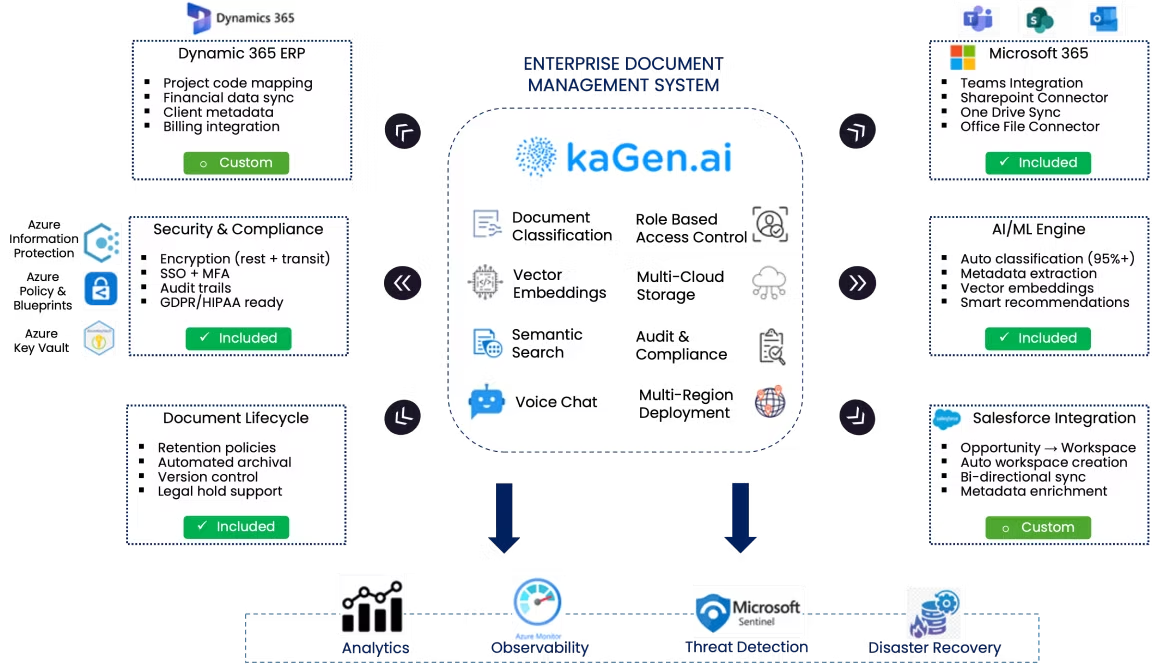
Kagen.ai Enterprise DMS architecture illustrates its AI modules, integrations, and cloud infrastructure for resilience and security.
The architecture diagram above shows how Kagen.ai’s components interconnect to deliver a resilient, scalable, and secure DMS. At the center is the AI-powered DMS core – this is the engine that handles document ingestion, storage, indexing (with vector embeddings for semantic search), and AI/ML processing (for classification, Q&A, summarization, etc.). Surrounding the core are integration adapters for external systems: on one side, connectors to Microsoft 365 (Teams, SharePoint, OneDrive, etc.), Salesforce CRM, and Dynamics 365 ERP; on the other side, an AI/ML engine module and integration points for other tools or custom agents. These adapters ensure that the DMS can bi-directionally sync with other platforms (for example, when a file is added in SharePoint, it’s indexed by Kagen; when a document is classified in Kagen, the tag might sync back to Salesforce). This design greatly improves interoperability and user adoption, since the DMS doesn’t operate in isolation but as part of your existing IT ecosystem.
Notice the Security and Compliance layer in the diagram. This includes features like encryption of data (both in transit and at rest), Single Sign-On and MFA via identity providers, and the enforcement of role-based permissions. It also covers the audit logging mechanism. This layer ensures that all interactions with the system are secure and tracked. The architecture has “Security & Compliance (Included)” highlighted, meaning things like encryption, RBAC, audit trails, and regulatory compliance features are built-in capabilities, not afterthought add-ons. This dedicated layer hardens the entire system – every file that flows through the DMS is subject to encryption and policy checks, and every user action is authenticated and logged. Such an approach contributes to both security (by preventing unauthorized actions) and scalability (by providing a consistent framework that can be applied across thousands of users and millions of documents without performance degradation).
Another component shown is Document Lifecycle Management, which addresses retention, archival, legal holds, and versioning (also marked as included). This part of the architecture handles the rules and schedules for document retention and deletion, ensuring compliance and efficient storage use. It contributes to resilience by preventing uncontrolled data growth (which can slow systems down) and ensuring important records are retained as needed. It also ties into security – for instance, ensuring that expired content containing sensitive data is properly disposed of is a security measure and a compliance requirement. By embedding lifecycle management, Kagen.ai’s architecture ensures the system can scale over time without accumulating unnecessary data baggage, and that it can respond to legal events (e.g., instituting a legal hold across relevant documents) in a managed way.
The bottom of the diagram highlights Observability and Threat Detection integrations: specifically, Azure Monitor for observability and Microsoft Sentinel for threat detection. These components feed system metrics and security events, respectively, into external services that specialize in monitoring and alerting. Azure Monitor provides dashboards and alerts on the health of the DMS – such as usage trends, performance metrics, error rates – which helps maintain scalability and reliability. For example, if document upload throughput is approaching a threshold, ops teams get alerted and can scale resources proactively. Microsoft Sentinel integration means that all security-relevant events (e.g., multiple failed login attempts, unusual download patterns, permission changes) are sent to the SIEM where advanced correlation and incident management can occur. This greatly boosts the security responsiveness of the platform: security teams can analyze DMS events in context with network and identity logs to spot sophisticated threats. It’s in this way that Kagen’s DMS doesn’t just secure itself, but actively participates in the enterprise’s broader security defense ecosystem. By architecting these hooks, Kagen.ai ensures that using its DMS will augment an organization’s security posture, not exist as a blind spot.
Crucially, the architecture supports multi-region deployment (often depicted with multiple cloud icons or region labels in the diagram). Kagen.ai can deploy its core services across data centers in different regions, with data replication and failover mechanisms. This design contributes to high availability and resilience – if one region goes offline due to, say, a network outage or natural disaster, the system fails over to another region with minimal downtime. In a multi-region deployment, user traffic is typically served by the nearest or healthiest region, which also improves performance globally. The diagram’s inclusion of a Disaster Recovery component underscores that the system is designed for worst-case scenarios. Regular backups and cross-region replication mean that even in catastrophic events, there’s a plan for continuity. As one source emphasizes, multi-region architectures “ensure uninterrupted service, minimizing downtime and safeguarding data,” and Kagen’s setup embodies that principle.
On the AI side, the AI/ML Engine part of the architecture (illustrated likely with an AI brain icon or similar in the diagram) is what powers the intelligent features: things like the 95% accurate auto-classification, metadata extraction, and recommendations (as listed in the diagram). This engine is tightly integrated with the document store and search index. It means the platform is AI-native – unlike bolt-on AI features, here the AI functionality is woven through the system. Every document ingested goes through the AI pipeline for analysis, and every query can invoke the AI models for tasks like summarization or Q&A. Architecturally, this is significant for scalability: the AI services can be scaled horizontally (adding more AI processing nodes) as document volume or query load increases. They likely use microservices or containerized deployments that can auto-scale under heavier load, ensuring that whether you have 1 million documents or 100 million, the AI-driven features remain responsive. The close coupling of AI also means new improvements to models can be deployed platform-wide seamlessly (e.g., swapping in a more accurate language model improves all features at once).
Finally, the architecture shows Integration with External Systems (like M365, Salesforce, D365 ERP) labeled as either “Included” or “Custom” depending on the connector. For example, Microsoft 365 integration might be included and ready to go, while a Dynamics 365 ERP integration might be a custom add-on depending on client needs. The presence of these in the architecture highlights interoperability as a design principle. It contributes to the scalability of adoption: the DMS can scale across an enterprise more easily when it fits into existing workflows (users don’t have to change all their habits). It also touches security: by integrating with systems of record like ERP and CRM, you reduce shadow IT and unauthorized document handling – everything funnels through a managed, secure system.
In summary, Kagen.ai’s architecture is a blueprint for an enterprise-grade, resilient, and secure AI DMS. Every component – from multi-region cloud infrastructure, to built-in security modules, to AI services and integration points – plays a role in ensuring the platform can scale to large enterprise demands while safeguarding data at every step. This kind of robust design is what differentiates an AI experiment from a production-ready solution. As a result, CTOs can trust that adopting Kagen’s DMS will enhance their infrastructure’s reliability and security, not strain it. Notably, Kagen.ai is a Microsoft Gold and AWS technology partner, reflecting its commitment to operate seamlessly in those ecosystems.
AI-Native DMS vs. Legacy Systems: A New Standard
It’s worth concluding with a direct comparison of AI-native DMS platforms like Kagen.ai’s to the more traditional or legacy document management systems many organizations have used in the past. The differences are stark, and they underscore why adopting an AI-enabled DMS is a strategic move for future-proofing enterprise workflows and compliance.
- Intelligence & Automation: A legacy DMS primarily stores files and requires significant manual effort to organize and process content. An AI-native DMS, by contrast, automatically classifies and tags documents, extracts key data, and can even generate insights (summaries, related document suggestions) without human intervention. This automation of routine tasks means fewer errors and faster processing. For example, a traditional system might rely on staff to input metadata or sort documents, whereas an AI system does it instantly, 24/7. Over time, the AI system also learns and improves, whereas a legacy system remains static. The bottom line is operational efficiency: AI handles the grunt work, so employees spend less time on mundane tasks.
- Search & Knowledge Retrieval: Traditional systems typically offer keyword-based search, which can be frustratingly slow and inaccurate if users don’t remember exact terms or if documents use different language. AI-enabled DMS provides semantic search with natural language understanding, yielding far more relevant results (and even answering questions directly). Users can ask things like, “find the email policy from last year” and get the exact policy document, even if it wasn’t labeled with those exact words. Legacy DMS might return a heap of files that contain any of those keywords, leaving the user to dig through. The AI-native approach dramatically reduces search time and increases confidence that you found the right thing. In knowledge-centric environments, this is a competitive advantage – employees who can get answers quickly make better decisions and serve customers faster. In fact, enterprises report that AI-based search reduces average information retrieval time from hours to seconds, a transformational productivity gain. In knowledge-centric environments, this is a competitive advantage – employees who can get answers quickly make better decisions and serve customers faster.
- Collaboration & User Experience: Legacy DMS platforms often feel like vaults – users put documents in and take them out, but the system doesn’t facilitate collaboration beyond maybe basic version control. AI-native systems, however, often come with collaborative AI assistants, chat interfaces, and integrations that fit naturally into how people work together. As we saw, features like multi-user chat with an AI or voice queries enable new forms of collaboration that legacy systems cannot support. Additionally, AI can help ensure everyone is working on the latest version by proactively informing users or even merging feedback. Traditional DMS might just warn of a checkout; an AI DMS can summarize changes between versions or suggest who should review a document next. The result is teams that are more aligned and spend less time emailing documents around. It’s a shift from document management to knowledge engagement – the system actively participates in collaboration.
- Security Posture: Security in older DMS solutions was often limited to access permissions and maybe basic encryption. They lacked active defenses. In contrast, as discussed, AI-driven DMS platforms provide real-time anomaly detection, automated threat alerts, sensitive data identification, and integrated security workflows. A legacy system might log events for later review, whereas an AI system is watching and responding in the moment. Also, modern DMS platforms usually come with more robust encryption and zero-trust architecture (every action is verified), whereas older ones might have weaker points (e.g., desktop sync clients storing unencrypted files). Furthermore, compliance enforcement is significantly improved in AI-native systems: automated audit trails and policy checks vs. manual procedures in legacy. As a consequence, organizations on AI-enabled platforms can reduce risk of data breaches and non-compliance incidents. If a suspicious activity happens at 2 AM, an AI DMS could flag or stop it immediately – a legacy system would likely only reveal it in an audit report weeks later. In today’s threat landscape, that difference is critical.
- Compliance and Auditability: With increasing regulations on data (GDPR, HIPAA, SOX, etc.), the ability to demonstrate compliance is key. Legacy DMS often require manual audits, bolt-on audit trail modules, or separate record-keeping systems. Many older systems struggle with things like global retention policy enforcement across all content types or quickly producing an audit trail for a regulator. AI-native DMS are built with compliance in mind: every document’s lifecycle is tracked, and rules can be codified so that the system automatically enforces them (e.g., “flag any document that contains a credit card number and quarantine it”). They maintain comprehensive audit logs and can automate compliance checks in real time. For example, if a document is about to be moved outside the company and it contains personal data, the DMS can prompt a GDPR compliance check or require a manager’s approval. These kinds of intelligent safeguards go well beyond what legacy systems offer. Thus, an AI-native DMS not only reduces the likelihood of a compliance violation but also makes it easier to prove compliance during audits by having all evidence readily available and well-organized. It’s an auditor’s dream to see every change, access, and action clearly recorded – something modern DMS deliver by default.
- Scalability & Flexibility: Finally, consider scalability. Legacy DMS were often limited by older architectures – a single server, or a monolithic design that gets slow as repositories grow. Scaling them can be expensive or technically challenging (e.g., sharding content manually). AI-era DMS, especially cloud-native ones like Kagen’s, are designed to scale horizontally on demand. Need to handle millions of documents across multiple locations? A modern DMS can do that with consistent performance, leveraging cloud infrastructure and distributed indexing. They also offer flexible deployment (cloud, on-prem, hybrid) to meet various regulatory or IT requirements, whereas older systems might have only one mode (often on-premises only). This means AI-native solutions adapt to your needs – whether you’re expanding globally, integrating new data sources, or handling spikes in usage – without a decline in user experience. In addition, updates and new features (like improved AI models or integrations) can be rolled out continuously in modern platforms, whereas legacy ones might need rare, disruptive upgrades. The agility of an AI-native DMS ensures it stays current with technology and threats, whereas a legacy system grows more outdated each year.
To put it succinctly, AI-native DMS platforms represent a new standard: they are intelligent, proactive, and built for the dynamic, security-conscious enterprise. Legacy DMS, while they may have served well in the past, simply cannot compete with the level of automation, insight, and protection that modern AI-driven systems provide. Companies that switch to AI-enabled document management often find immediate gains – faster workflows, fewer errors, stronger security – which translate into cost savings and reduced risk. For instance, one entrepreneur reported that after implementing AI auto-tagging, “documents were classified in minutes instead of days, reducing retrieval time by 70% and cutting errors,” which even made audits smoother since files were already well-organized. Those kinds of improvements are very hard to achieve with older technology.
From a strategic perspective, adopting an AI-enabled DMS like Kagen.ai’s is not just an IT upgrade, it’s an innovation catalyst. It unlocks the value in your company’s document corpus, turning it into a readily accessible knowledge base with insights at your fingertips. It also acts as a force multiplier for your IT governance and security teams, automating many compliance and monitoring tasks. In contrast, sticking with a legacy or non-AI DMS might mean continuing to pour valuable staff hours into manual document handling and reacting to issues after the fact. In a competitive and regulated business environment, that’s a disadvantage no organization wants.
Conclusion
AI-powered enterprise document management systems are rapidly becoming indispensable for organizations that want to streamline operations and strengthen their information governance. They bring together the best of both worlds: enabling employees to find and use information faster (driving productivity and innovation), while simultaneously tightening security controls and compliance (reducing risk). Features like automated summarization, intelligent tagging, semantic search, visual analytics, collaborative AI assistants, and AI-driven security monitoring are not science fiction – they are here now, transforming workflows in forward-thinking companies. And platforms like Kagen.ai’s Enterprise DMS exemplify this transformation by offering an integrated suite that is AI-first and enterprise-ready. Kagen.ai combines powerful AI/ML capabilities (from classification to voice chat) with rock-solid security, multi-cloud resilience, and deep integration into the tools businesses already use. The result is a DMS that doesn’t just store documents, but actively understands, accelerates, and protects the work you do with those documents.
For CTOs and IT decision-makers, the message is clear: investing in an AI-native DMS is an investment in the intelligence and agility of your organization’s knowledge workflows. It’s an upgrade that can pay dividends in efficiency gains, improved decision-making, and peace of mind on the security front. The gap between AI-enabled DMS and legacy systems will only widen as AI models get smarter and threats more complex. Embracing a solution like Kagen.ai’s now positions your enterprise to stay ahead of the curve – turning your document management from a bottleneck into a competitive advantage, all while keeping your data safe and compliant. In the digital era, information is power, and an AI-powered DMS ensures you can wield that power effectively and responsibly.
- How is AI transforming document management?
- AI for document management: What works for growing teams
- What is semantic search and how does it work? | Parallel Web Systems | Build the world wide web for AIs
- New AI-Driven Semantic Search and Summarization Discover AI-Driven Semantic Search and Summarization for Meraki API
- A new way to collaborate with Copilot in Teams chats | Microsoft Community Hub
- How Document Management Systems Support Compliance | M-Files
- Best Document Management Systems in 2025 | Accruent
- Unify Your Enterprise Intelligence with Kagen
- Why Multi-Region Cloud Support Is Essential – New Horizons – Blog | New Horizons