


How Kagen ADD Uses Multi-Agent Intelligence to Build, Validate, and Deliver Better Software
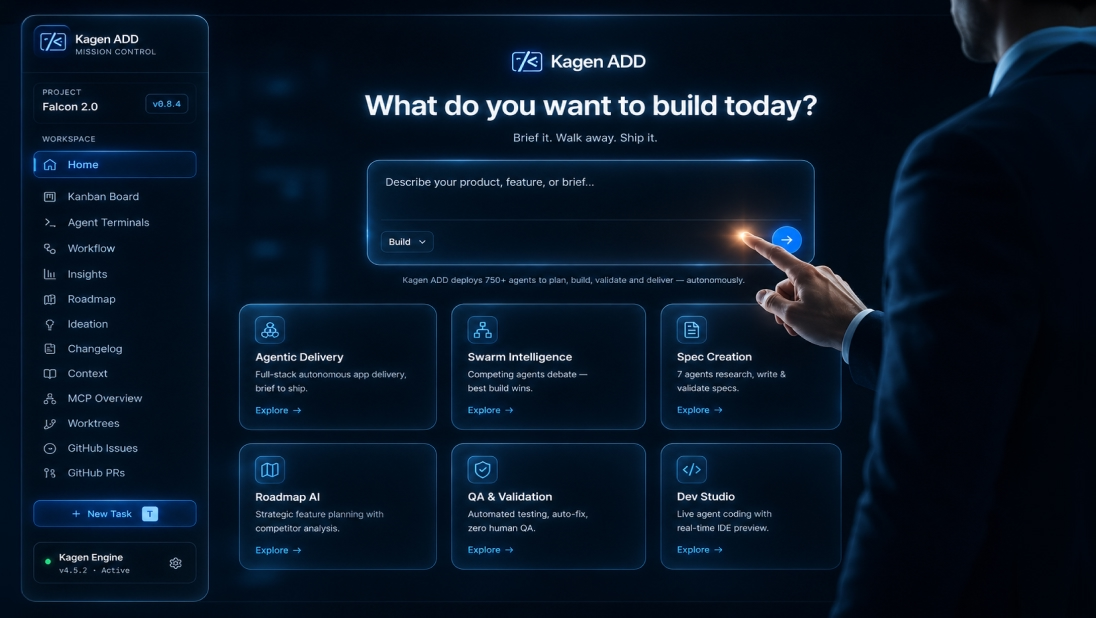
Software delivery has reached a breaking point.
Enterprise teams are under constant pressure to release faster, improve quality, reduce costs, and adapt to changing business priorities. Yet traditional development models continue to rely on fragmented workflows, siloed teams, manual handoffs, and lengthy review cycles.
Adding more developers no longer guarantees faster outcomes. Increasing automation often creates new governance challenges. The result is a software development lifecycle that struggles to keep pace with modern business demands.
This is where Multi-Agent Intelligence for Software Development is changing the equation.
Instead of relying on a single AI assistant to generate code, modern enterprises are embracing coordinated networks of specialized AI agents that can design, develop, test, validate, and optimize software simultaneously. This shift is giving rise to a new model of AI-powered software development workflows where multiple intelligent agents work together as an integrated delivery system.
Kagen ADD (Agentic-Driven Delivery) is built on this principle. It combines multi-agent intelligence, governance, and enterprise-grade orchestration to create a smarter, faster, and more reliable path to software delivery.
The Evolution from AI Assistance to Multi-Agent Software Development
Most organizations experimenting with AI in engineering start with coding assistants.
These tools help developers generate snippets, suggest fixes, and accelerate repetitive tasks. While valuable, they typically operate in isolation and depend heavily on human intervention.
True transformation begins with Multi-Agent Software Development.
In a multi-agent environment, different AI agents are assigned specialized responsibilities across the software lifecycle. Rather than functioning as standalone tools, these agents collaborate, validate each other's outputs, and continuously coordinate through structured workflows.
This approach creates an ecosystem where software delivery becomes an orchestrated process rather than a collection of disconnected activities.
The result is a shift from AI-assisted development to agentic software engineering, where intelligent systems actively participate in execution while maintaining enterprise governance and human oversight.
Understanding Kagen ADD's Multi-Agent Architecture
At the core of Kagen ADD is a sophisticated multi-agent architecture designed specifically for enterprise software engineering.
Rather than depending on one general-purpose AI model, Kagen ADD deploys multiple specialized agents that work together within a governed framework.
These collaborative AI agents may include:
- Business requirement analysis agents
- Solution design agents
- Code generation agents
- Test creation agents
- Security validation agents
- Compliance review agents
- Documentation agents
- Quality assurance agents
Each agent focuses on a specific area of expertise while remaining connected to the broader delivery workflow.
Together, they form an intelligent AI agent ecosystem capable of handling complex development initiatives at scale.
This structure enables organizations to move beyond isolated automation toward true autonomous software development.
How Multi-Agent Intelligence Builds Software
One of the biggest misconceptions about AI development is that software generation is simply a coding problem.
In reality, enterprise delivery involves far more than writing code.
Successful software projects require:
- Requirement analysis
- Architecture planning
- Technical design
- Coding
- Testing
- Security validation
- Documentation
- Release preparation
- Performance optimization
This is where how multi-agent AI builds software becomes fundamentally different from conventional AI tools.
When a project enters Kagen ADD, the system initiates a coordinated workflow among multiple agents.
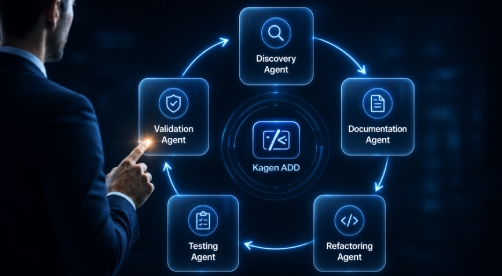
A requirements agent interprets business objectives.
A design agent translates those objectives into technical architecture.
Development agents generate implementation approaches.
Validation agents review outputs for quality, security, and compliance.
Testing agents create and execute test scenarios.
Documentation agents maintain project knowledge and delivery records.
Instead of sequential execution, these activities often occur simultaneously through intelligent agent workflows, significantly reducing delivery timelines.
Also read- Kagen ADD: Rebuilding the Enterprise SDLC for the Agentic AI Era
Agent Orchestration: The Intelligence Behind Coordination
The true power of Kagen ADD lies not only in its agents but in its agent orchestration layer.
Without coordination, multiple AI agents simply create complexity.
Orchestration ensures that every agent operates within defined objectives, governance rules, and business priorities.
Kagen ADD continuously manages:
- Task allocation
- Workflow sequencing
- Dependency management
- Validation checkpoints
- Decision routing
- Human approval requirements
This enables seamless collaboration between agents while maintaining enterprise-grade control.
Through advanced agent orchestration, organizations gain the benefits of speed without sacrificing accountability.
The result is a highly structured model for AI-driven software delivery that remains transparent and auditable.
AI Agents Across the Software Development Lifecycle
Traditional software projects often suffer from bottlenecks created by team handoffs.
Requirements move to architects. Architects hand work to developers. Developers pass code to testers. Security reviews happen later. Documentation is often delayed until the end.
Kagen ADD removes many of these bottlenecks by deploying AI agents across the software development lifecycle.
1. Requirements and Discovery
AI agents analyze stakeholder inputs, identify ambiguities, and generate structured requirement documentation.
2. Architecture and Design
Specialized agents propose solution designs, assess scalability requirements, and recommend implementation patterns.
3. Development
Development-focused agents generate code, refactor components, and optimize implementations.
4. Testing
Testing agents create automated test suites, identify edge cases, and execute validation scenarios.
5. Security and Compliance
Security-focused autonomous AI agents continuously evaluate vulnerabilities, policy adherence, and compliance requirements.
6. Documentation
Documentation agents generate technical specifications, release notes, and operational knowledge artifacts.
This creates a unified AI development lifecycle where every phase benefits from intelligent automation.
The Role of Collaborative Validation
Speed alone is not enough.
Enterprise software requires trust.
One of Kagen ADD's most powerful capabilities is its use of collaborative validation through multiple agents.
Instead of accepting a single generated output, several agents independently evaluate proposed solutions.
These collaborative AI agents challenge assumptions, identify risks, and compare alternative approaches before final recommendations are produced.
This creates a system of AI-driven peer review.
The outcome is higher-quality software with fewer defects, stronger security posture, and greater reliability.
This validation-first approach helps organizations avoid one of the biggest risks associated with generative AI: unquestioned outputs.
AI-Native SDLC: A New Operating Model for Delivery
Most organizations attempt to insert AI into existing development processes.
Kagen ADD takes a different approach.
It is built around an AI-native SDLC, where intelligence is embedded throughout the entire delivery process from the beginning.
In an AI-native SDLC, agents actively participate in:
- Planning
- Design
- Development
- Testing
- Governance
- Optimization
- Release management
Rather than supporting isolated tasks, AI becomes an operational layer across delivery.
This transforms software execution into a continuously improving system capable of learning from outcomes and refining future decisions.
The result is a more adaptive model for intelligent software development.
Multi-Agent Intelligence for Enterprise Software Delivery
Enterprise environments introduce unique challenges that generic AI tools often struggle to address.
These include:
- Regulatory compliance
- Complex workflows
- Legacy integrations
- Security requirements
- Governance standards
- Large-scale collaboration
Kagen ADD addresses these realities through multi-agent intelligence for enterprise software delivery.
Its architecture enables agents to access contextual business knowledge, enterprise systems, internal documentation, and operational data while respecting organizational controls.
This context-aware execution allows agents to make more informed decisions and produce outcomes aligned with enterprise objectives.
The platform becomes a governed environment for AI-powered engineering, not simply a collection of automation tools.
Also read: The 2026 Enterprise AI and AI Voice Agent Buying Guide You Need to Bookmark
Accelerating Software Delivery Automation
One of the most significant benefits of Kagen ADD is its impact on delivery speed.
Traditional projects often lose substantial time to:
- Requirement clarification
- Manual reviews
- Testing cycles
- Documentation efforts
- Communication delays
Through intelligent coordination and automation, Kagen ADD dramatically improves software delivery automation.
Multiple agents work in parallel rather than waiting for sequential handoffs.
Testing begins alongside development.
Documentation evolves continuously.
Validation occurs throughout the process rather than at the end.
This creates a highly efficient model for autonomous software delivery using AI agents.
Organizations can accelerate releases while maintaining quality and governance standards.
Why Agentic AI Represents the Future of Software Engineering
The next evolution of software delivery will not be defined by larger development teams.
It will be defined by intelligent systems capable of executing complex workflows autonomously.
This is the promise of agentic AI for software engineering.
As organizations increasingly adopt multi-agent systems, software delivery will become more adaptive, scalable, and resilient.
AI agents will move beyond assisting developers to actively participating in execution, decision-making, validation, and optimization.
The future belongs to organizations that can combine human expertise with intelligent execution frameworks.
Kagen ADD provides that foundation through governed autonomy, advanced orchestration, and enterprise-ready multi-agent software development platform capabilities.
Conclusion: Deliver Faster, Validate Smarter, Scale with Confidence
The software delivery landscape is evolving rapidly.
Enterprises can no longer rely on fragmented processes, manual coordination, and linear execution models to meet growing business demands.
Kagen ADD introduces a new approach powered by multi-agent intelligence, where specialized AI agents collaborate across the entire development lifecycle to build, validate, and deliver software with greater speed, quality, and confidence.
By combining AI agents for software development, advanced orchestration, collaborative validation, and an AI-native SDLC, Kagen ADD helps organizations transform software delivery from a resource-intensive process into an intelligent execution engine.
Whether you're looking to accelerate innovation, improve quality, strengthen governance, or modernize your engineering operations, Kagen ADD provides the framework for the next generation of AI software development.
Ready to transform software delivery with multi-agent intelligence?
Discover how Kagen ADD enables governed, enterprise-grade autonomous execution across the software lifecycle. Connect with our experts to see how agentic delivery can help your teams build faster, validate smarter, and deliver better software at scale.



%20and%20Why%20It%20Will%20Replace%20Traditional%20SDLC/What%20Is%20Agentic-Driven%20Delivery%20(ADD)%20and%20Why%20It%20Will%20Replace%20Traditional%20SDLC%202%20thum.avif)