Cognitive Document
Intelligence

Powering the Next Era of Enterprise Automation
WHITEPAPER

cover image

Executive Summary

Enterprises are operating in an environment where information volume is growing faster than organizational capacity to manage it. Contracts, policies, technical documentation, customer records, regulatory filings, and operational content now span thousands of repositories, formats, and systems. Yet most organizations still rely on document management approaches designed for an era when scale, compliance, and decision velocity were secondary concerns.

Traditional Document Management Systems (DMS), optimized for storage and retrieval, no longer meet enterprise demands. Intelligent Document Processing (IDP) tools improve document extraction, classification, and enables governed, enterprise-wide intelligence. Meanwhile, ungoverned Large Language Model (LLM) deployments introduce new risks around data exposure, auditability, and compliance.

The result is a widening gap between document volume and document intelligence. This whitepaper examines why document management continues to fail at scale, how fragmented approaches erode productivity and trust, and why enterprises must shift from document storage and processing to intelligent, governed document intelligence. We will also explore Kagen PRISM, an AI-first content intelligence platform developed by Kagen and powered by Successive Digital, designed to transform unstructured enterprise documents into searchable, governed, and actionable knowledge - without compromising security, compliance, or operational control.

Table of Contents

  • 1. Introduction
  • 2.The Document Management Gap in Modern Enterprises
  • 3.Kagen PRISM: AI-First Content Intelligence Platform
  • 4.Trust, Security, and Compliance by Design
  • 5.Enterprise Use Cases and Proven Impact
  • 6.From Fragmented Governance to a Unified Document Intelligence Framework
  • 7.Deployment Approach
  • 8.Business Impact and Measurable Outcomes
  • 9.Unlocking Enterprise Value Through Cognitive Document Intelligence
  • 10.About Kagen.ai

1. Introduction

Across modern enterprises, documents remain one of the largest yet least optimized sources of operational data. Contracts, invoices, compliance records, reports, and customer documentation contain critical information that drives decisions and workflows. Yet much of this information remains locked inside unstructured formats and scattered across repositories, collaboration tools, emails, and legacy systems. Gartner notes that enterprises now manage information across hundreds of applications and repositories, making document discovery and governance increasingly complex.

The scale of the challenge is significant. Research cited by Forbes indicates that 80-90% of enterprise data is unstructured, existing in documents, emails, PDFs, presentations, and multimedia rather than structured databases. As this volume grows, organizations struggle to analyze, govern, and operationalize information effectively.

The operational impact is equally substantial. Deloitte research shows that knowledge workers spend nearly 1.8 hours every day, almost 9 hours per week, searching for information across enterprise systems. In many organizations, employees spend 30-40% of their time locating, validating, or recreating information stored in documents and emails, creating productivity bottlenecks and delaying decision-making.

Traditional document management systems were designed primarily for storage and organization, not for interpreting document meaning. Rule-based automation can process structured inputs but often fails when faced with varied formats, languages, and contextual data embedded within enterprise documents.

Cognitive Document Intelligence changes this paradigm. By combining Artificial Intelligence, natural language processing, and machine learning, cognitive systems enable enterprises to understand document content, classify information automatically, extract key insights, and connect document intelligence directly to business workflows. Gartner predicts that more than 80% of organizations will adopt generative AI technologies by 2026, further increasing the need for intelligent systems capable of governing enterprise information.

This shift marks the emergence of a new era in enterprise automation, where documents are no longer passive files but intelligent assets that drive faster decisions, strengthen compliance, and unlock the full value of enterprise knowledge.

2. The Document Management Gap in Modern Enterprises

Enterprises rely heavily on documents to run critical operations, from compliance and contracts to internal knowledge and customer interactions. Yet many organizations still operate with fragmented systems that limit visibility, control, and efficiency. As document volumes grow, manual processes and disconnected repositories create operational bottlenecks.

Document workflow automation is emerging as a key capability for enterprises looking to streamline document-driven processes and improve operational agility. Understanding this reality is essential before organizations can transform how enterprise documents are managed and activated.

2.1 The Cost of Manual and Rule-Based Document Operations
2.1 The Cost of Manual and Rule-Based Document Operations

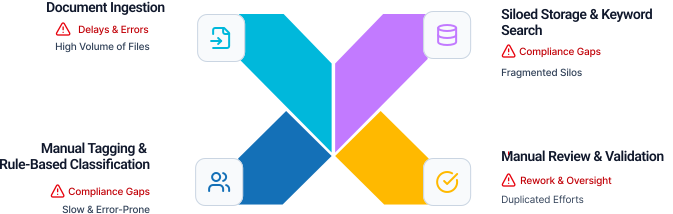
Most enterprise document workflows still rely on manual effort or rigid rule-based systems that struggle to keep pace with the scale and complexity of modern information environments. Employees spend significant time reviewing, organizing, and routing documents, while rule-based automation processes content using predefined templates that often fail when document formats or business requirements change. As document volumes grow, these limitations create operational bottlenecks and inconsistencies in how information is processed and stored.

This growing complexity is driving enterprises to explore AI document processing capabilities that can understand, classify, and manage documents more intelligently. Without such advancements, what begins as a workflow inefficiency gradually evolves into a broader organizational challenge affecting productivity, governance, and decision-making.

Key challenges typically include:

Manual Document Handling

Employees spend significant time tagging, organizing, and routing documents manually, which slows workflows and introduces inconsistencies in how information is classified and stored.

Rigid Rule-Based Automation

Traditional automation depends on predefined rules that work only for predictable formats. When documents vary in structure, terminology, or language, these systems fail to process information accurately.

Limited Scalability

As document volumes grow across departments and repositories, manual and rule-based approaches struggle to keep pace, leading to delays in document processing and retrieval.

Inconsistent Data Quality

Human error and inconsistent tagging reduce metadata quality over time, making documents harder to find, validate, and govern.

Rising Operational Costs

The cumulative impact of manual effort, inefficient workflows, and system limitations increases operational costs while reducing organizational agility.

2.2 Why Traditional Document Management System (DMS) Breaks at Scale

2.2 Why Traditional Document Management System (DMS) Breaks at Scale

Most enterprise document workflows still rely on manual effort or rigid rule-based systems that struggle to keep pace with the scale and complexity of modern information environments. Employees spend significant time reviewing, organizing, and routing documents, while rule-based automation processes content using predefined templates that often fail when document formats or business requirements change. As document volumes grow, these limitations create operational bottlenecks and inconsistencies in how information is processed and stored.
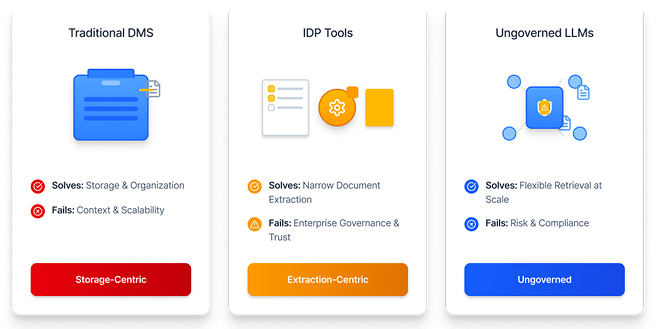
Traditional DMS platforms were built to solve storage and access, not understanding. Their core capabilities - folder hierarchies, static metadata, and keyword search - assume consistency in document structure, terminology, and user behavior. In modern enterprises where documents are created continuously across teams, systems, and regions, those assumptions no longer hold. As scale increases, what once functioned as an organized repository becomes brittle and difficult to manage. 

As information volumes grow, employees increasingly struggle to locate relevant knowledge. McKinsey research shows that knowledge workers spend about 19% of their workweek searching for and gathering information across systems. Keyword-based search surfaces noise instead of relevance because it lacks semantic understanding and cannot interpret context or intent. At the same time, documents spread across multiple repositories with no connective intelligence, forcing users to manually reconstruct meaning and relationships across systems.

Governance is typically applied unevenly or after the fact, with access controls and audit mechanisms layered onto storage rather than embedded into the document lifecycle. Over time, retrieval slows, confidence in information declines, and teams create workarounds that further fragment enterprise knowledge. At scale, traditional DMS does not fail abruptly - it degrades quietly, becoming a structural constraint on speed, compliance, and informed decision-making.

2.3 Why IDP-Only and LLM-First Approaches Fall Short

2.3 Why IDP-Only and LLM-First Approaches Fall Short

Intelligent Document Processing (IDP) tools improve extraction and classification but are typically scoped to narrow workflows - such as invoice processing, form digitization, or specific document types. While effective for structured tasks, these tools rarely extend beyond isolated use cases and often lack enterprise-wide governance, contextual retrieval, and cross-repository intelligence. According to Gartner, only about 30% of enterprises successfully scale automation initiatives beyond individual business processes, highlighting the difficulty of expanding task-level automation across the enterprise.

Conversely, LLM-first deployments promise flexibility and conversational access to information but introduce significant risks when deployed without proper control frameworks. Without role-based access controls, audit logs, retention policies, and explainability, organizations risk exposing sensitive data and failing compliance obligations. Deloitte reports that nearly 60% of organizations cite governance and risk management as their primary challenge when implementing enterprise AI systems.

As enterprises attempt to scale AI-driven document capabilities, it becomes clear that neither approach alone addresses the broader requirements of secure, governed, and enterprise-wide digital document management.

Key limitations typically include:

Limited Workflow Scope

EIDP systems are designed for specific document extraction tasks rather than managing the full document lifecycle. This restricts their usefulness in broader enterprise environments where documents must be discovered, governed, and connected across multiple systems.

Lack of Contextual Intelligence

Traditional IDP tools focus on data extraction but do not understand relationships between documents or their role in broader business processes. Without contextual awareness, enterprises struggle to convert extracted data into actionable knowledge.

Fragmented Information Ecosystems

When organizations rely on multiple specialized tools, documents remain scattered across repositories and workflows. This fragmentation limits visibility and prevents organizations from establishing a unified digital document management strategy.

Operational and Compliance Risks 

In regulated industries, document access, retention, and traceability are critical. Systems that do not embed governance and policy enforcement into document intelligence create compliance vulnerabilities and increase operational risk.

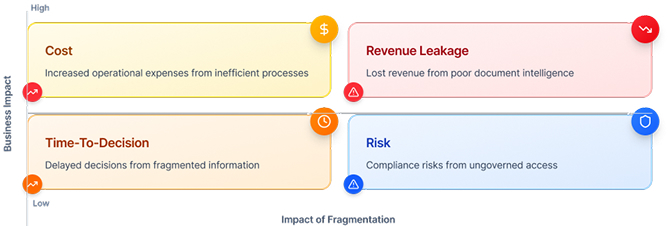
2.4 Business Impact: Cost, Risk, Time, and Revenue

2.4 Business Impact Cost, Risk, Time, and Revenue

The cumulative impact of fragmented document management is measurable and often underestimated until it begins to affect strategic outcomes. Redundant tools, manual effort, and repeated rework inflate operational costs as teams spend significant time locating, validating, and organizing information that should already be accessible. Slower document discovery delays decisions and execution, particularly in environments where compliance reviews, contract approvals, or operational workflows depend on accurate information retrieval. At the same time, inconsistent governance across repositories increases audit exposure and the likelihood of compliance failures, especially as regulatory scrutiny continues to intensify. When critical knowledge remains buried in disconnected systems, organizations also lose opportunities to act quickly on insights, reducing responsiveness in competitive markets.

As enterprises grow, these inefficiencies compound and become embedded in everyday operating models. Teams create workarounds to compensate for system limitations, duplicating files, maintaining parallel repositories, or recreating documents entirely. Over time, these behaviors increase risk, obscure accountability, and slow the flow of information across the organization. Document inefficiency then evolves from a productivity issue into a structural barrier that affects cost control, operational agility, and revenue potential. Without a more intelligent and governed approach to managing enterprise documents, organizations face rising operational drag and a widening gap between the information they possess and the value they are able to extract from it.

3. Kagen PRISM: AI-First Content Intelligence Platform

Kagen PRISM is an AI-first document management system that transforms enterprise documents into real-time, decision-ready intelligence. Instead of acting as a traditional repository, it unifies fragmented content across systems, enables semantic search and natural language queries, and delivers precise, context-aware insights, reducing manual effort and accelerating access to critical information.

Built for enterprise scale, the platform combines automated classification, AI-driven summaries, and zero-trust governance to ensure compliance, security, and audit readiness. By converting static documents into structured, actionable knowledge, it empowers CXOs to drive faster decisions, improve operational efficiency, and unlock enterprise-wide visibility across millions of documents.

The following capability snapshot highlights the key components that define the Kagen PRISM document intelligence platform.

3.1 Core Platform Capabilities

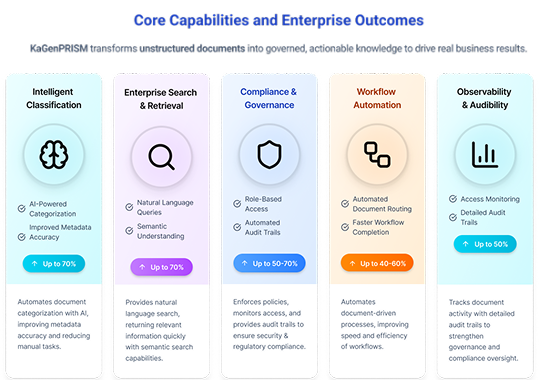
The core capabilities of Kagen PRISM are designed to enhance how enterprises manage and use their documents while delivering measurable business outcomes. By combining intelligent automation, semantic understanding, and built-in governance, the platform transforms unstructured content into actionable knowledge. Each capability helps reduce manual effort, accelerate decision-making, and strengthen compliance across document-intensive operations.

3.1 Core Platform Capabilities

1. Intelligent Classification

Automated, context-aware classification enables organizations to categorize unstructured documents accurately across the enterprise by analyzing their meaning, structure, and context rather than relying on rigid rules or manual tagging. Advanced AI models interpret document content to apply consistent classifications and metadata, allowing diverse document types - such as contracts, reports, policies, and operational records - to be organized intelligently as they enter the system. This eliminates the need for manual sorting and ensures that documents are structured within a unified knowledge framework, making them easier to discover, connect, and manage across multiple repositories and workflows.

The business impact of intelligent classification is substantial, particularly in environments where large volumes of documents are processed daily. Organizations that implement automated classification commonly experience up to 60% reduction in manual document handling, while improved metadata accuracy can increase document discoverability by nearly 70%. With documents consistently categorized and enriched from the moment they are ingested, teams can locate relevant information faster, reduce operational delays, and support more efficient collaboration and decision-making across the enterprise.

2. Enterprise Search and Retrieval

Natural language access to enterprise knowledge enables users to find information by asking questions in the way they naturally communicate, rather than relying on rigid keyword searches or navigating complex folder structures. Semantic search capabilities interpret user intent, context, and relationships between documents to surface the most relevant results across distributed repositories. Instead of returning long lists of loosely related files, the system delivers context-aware answers, summaries, and insights that connect documents to broader business knowledge, allowing employees to quickly understand and use the information they need.

The business impact of intelligent search and retrieval is significant, particularly in organizations where employees spend considerable time locating information across multiple systems. Studies indicate that knowledge workers spend nearly 20-30% of their time searching for information, and semantic search capabilities can reduce this effort by up to 70%. By enabling faster access to accurate knowledge, organizations can accelerate decision-making, improve productivity across teams, and ensure that critical information is readily available when needed for operations, compliance, or strategic planning.

3. Compliance and Governance

Policy enforcement and governance capabilities ensure that enterprise documents are managed in accordance with security policies, regulatory requirements, and internal compliance standards. Role-based access controls, controlled permissions, and continuous monitoring of document interactions help maintain visibility into how sensitive information is accessed and used. This ensures that governance policies are consistently applied across repositories while maintaining clear audit trails throughout the document lifecycle.

The business impact of strong compliance and governance controls is significant, particularly for organizations operating in regulated environments. Structured governance frameworks can reduce compliance-related risks by up to 50-70%, while automated audit trails improve audit readiness and reporting efficiency. By ensuring that documents remain controlled, traceable, and policy-compliant, enterprises strengthen their regulatory posture and reduce the operational burden associated with compliance management.

4. Workflow Automation

Document-driven workflow automation enables organizations to trigger actions such as routing, approvals, notifications, and archiving directly from document content without relying on manual intervention. By analyzing document context and applying predefined business rules, the system can automatically initiate the next step in a process, ensuring that documents move seamlessly across teams and systems. This reduces dependency on manual handoffs, minimizes delays in document-heavy operations, and ensures that critical processes continue to flow efficiently across the enterprise.

The business impact of workflow automation is reflected in faster operations and improved process efficiency. Organizations implementing automated document workflows often experience up to 40-60% faster process completion times and significantly reduced administrative effort. By eliminating manual bottlenecks and enabling documents to trigger actions automatically, enterprises can increase operational throughput, reduce process latency, and allow teams to focus on higher-value work rather than repetitive administrative tasks.

5. Observability and Auditability

Complete visibility into document usage enables organizations to monitor how documents are accessed, shared, and utilized across the enterprise. By tracking access patterns, user interactions, and governance enforcement in real time, organizations gain a clear view of how information flows within their systems. This level of transparency helps identify unusual activity, ensure that policies are consistently followed, and maintain detailed audit trails that support compliance and operational oversight across the document lifecycle.

The business impact of strong observability and auditability capabilities is significant for enterprises managing sensitive information. Organizations with comprehensive monitoring and audit systems can reduce governance and compliance risks by up to 50%, while improving incident response and investigation times by nearly 40%. By providing clear accountability for document access and usage, enterprises strengthen risk management practices and ensure greater transparency across critical business operations.


3.2 Comparative Analysis of Leading Document Intelligence Platforms

Organizations modernizing document management infrastructure typically evaluate a range of technologies, including traditional enterprise content management systems, intelligent document processing platforms, and emerging generative AI tools.

While these platforms provide valuable capabilities, most solutions focus on one part of the document lifecycle rather than providing a comprehensive enterprise knowledge platform.

This gap is significant because:

  • 80-90% of enterprise data exists in unstructured formats, including documents, PDFs, emails, and presentations.
  • Knowledge workers spend up to 30% of their time searching for information across systems, according to McKinsey.
  • Gartner estimates that organizations lose millions annually due to poor knowledge management and information silos.

The following comparison examines how leading enterprise platforms address key document management capabilities such as access control, lifecycle governance, workflow automation, and AI-driven knowledge discovery.

These capabilities align with core enterprise DMS requirements including:

  • Role-Based Access Control
  • Document Lifecycle Governance
  • Workflow Orchestration
  • Metadata-Based Retrieval
  • Audit Logging And Compliance Monitoring

3.3 Major Enterprise Platforms in the Market

1. Microsoft SharePoint / Microsoft Syntex

Delivers strong content management with seamless ecosystem integration, security, and collaboration features. However, it functions more as a repository than a full document intelligence platform, with limited AI maturity and discovery capabilities.

2. OpenText Content Suite

Well-established enterprise content management platform widely used in regulated industries, offering strong document lifecycle management, compliance, and governance capabilities. However, it has a complex architecture, limited AI-driven document understanding, high implementation costs, and a less modern user experience compared to cloud-native platforms.

3. Box Content Cloud / Box AI

Evolved from a cloud storage solution into an enterprise content management and collaboration platform with AI capabilities, offering strong cloud-native architecture, external collaboration, and document insights via Box AI. However, its AI is focused more on summarization than deep document intelligence, with limited workflow automation and governance often requiring third-party integrations.

4. Google Document AI

Cloud-based platform for extracting structured data using machine learning, offering high accuracy for documents like invoices and strong integration with Google Cloud. However, it is focused on data extraction rather than full document lifecycle management, with limited governance and weak collaboration capabilities.

5. UiPath Document Understanding

Offers document understanding as part of its RPA platform, enabling strong automation for document-heavy workflows with AI-driven data extraction. However, it is focused more on process automation than enterprise knowledge management, with limited semantic search across document repositories.

6. ABBYY Vantage

Intelligent document processing platform known for strong OCR, document classification, and pre-trained AI models for common document types. However, it is primarily focused on extraction workflows, with limited support for enterprise knowledge discovery and full document lifecycle governance.

3.4 Capability Comparison

The following table compares how leading enterprise platforms address key document management capabilities.

Capability SharePoint
Syntex
OpenText Box AI Google
Document AI
UiPath ABBYY Kagen
PRISM
Document repository × × ×
Document lifecycle governance Limited Limited × × ×
AI document classification Limited Limited
Semantic search Limited Limited Limited Limited × ×
Workflow automation Limited Limited Limited Limited
Policy-driven access control Limited × × ×
Audit logging and compliance Limited Limited Limited Limited
Enterprise integrations Limited Limited
Knowledge graph discovery × × × × × ×

3.5 Why Kagen PRISM Stands Out

End-to-End Document Lifecycle Intelligence
Covers the complete lifecycle from ingestion and classification to retention, governance, and policy enforcement.

Semantic Knowledge Discovery
AI-driven search enables users to retrieve documents based on meaning, context, and intent rather than keywords.

Enterprise Governance by Design
Policy-based access control, audit logging, and retention management are embedded directly into the platform.

Deep Enterprise Integrations
Seamlessly integrates with CRM, ERP, and collaboration tools to keep documents connected to business workflows.

Knowledge Graph–Driven Insights
Connects relationships between documents, users, and projects to uncover hidden enterprise knowledge.

4. Trust, Security, and Compliance by Design

Enterprise adoption of AI-driven document intelligence depends fundamentally on trust. Organizations must ensure that sensitive information is protected, governance policies are enforced consistently, and every interaction with enterprise data remains transparent and accountable. Kagen PRISM is engineered with security and compliance as foundational requirements rather than optional add-ons. From the moment documents enter the system, security controls are embedded directly into the intelligence pipeline to ensure that data remains protected while still enabling intelligent retrieval, automation, and knowledge discovery.

The platform incorporates enterprise-grade safeguards such as data isolation across tenants and repositories, role-based access control aligned with enterprise identity and access management (IAM) systems, and end-to-end audit logging for document access, queries, and automated actions. These controls ensure that every interaction with enterprise content remains traceable and policy-compliant. In addition, Kagen PRISM supports governance frameworks aligned with standards such as SOC 2 and ISO, enabling organizations operating in regulated environments to maintain strong compliance postures. Flexible deployment options across cloud, hybrid, and controlled enterprise infrastructures further ensure that the platform can integrate securely into existing IT environments while meeting both operational and regulatory requirements.

5. Enterprise Use Cases and Proven Impact

Cognitive Document Intelligence is not a theoretical capability, it is actively transforming how enterprises operate across industries. From highly regulated sectors like BFSI and healthcare to operationally intensive environments like construction and manufacturing, organizations are leveraging AI-driven document intelligence to eliminate inefficiencies, reduce risk, and accelerate outcomes.

The following use cases illustrate how Kagen PRISM enables enterprises to move from fragmented document ecosystems to intelligent, connected workflows, delivering measurable business impact at scale.

5.1 Banking & Financial Services

Banks manage large volumes of compliance documents like KYC and AML records, often scattered across systems. This leads to delays and audit risks. Kagen PRISM uses AI to classify documents, enable natural-language search, and enforce compliance policies. It improves audit readiness, reduces manual effort, and ensures accurate regulatory submissions with full traceability.

5.2 Pharmaceuticals – Clinical Trial Documentation

Clinical trial documents are distributed across sites and systems, causing version control issues and delays. Kagen PRISM centralizes documents, automates classification into regulatory formats, and streamlines approval workflows. It ensures compliance, reduces errors, and accelerates regulatory submissions while maintaining complete document traceability.

5.3 Legal – Contract Lifecycle Management

Legal teams struggle to manage and analyze large volumes of contracts, leading to missed obligations and delays. Kagen PRISM enables clause-level search using natural language, automates alerts for renewals, and ensures secure access. It speeds up contract review, improves visibility, and reduces legal risks.

5.4 Healthcare – Patient Records Management

Healthcare providers handle patient records across multiple systems, making retrieval slow and risky. Kagen PRISM connects systems, enables instant document access using natural-language queries, and enforces secure, role-based access. It improves care delivery, reduces retrieval time, and ensures compliance with healthcare regulations.

5.5 Construction – Project Documentation & Compliance

Construction projects generate large volumes of documents across sites, causing delays and compliance risks. Kagen PRISM organizes documents by project, automates classification, and verifies subcontractor compliance. It speeds up onboarding, reduces missing documents, and improves project efficiency.

5.6 Maritime – Compliance Reporting

Maritime companies manage complex regulatory documents across global operations. Manual review slows compliance reporting. Kagen PRISM automates classification, summarizes reports, and enables quick search across documents. It improves reporting speed, reduces manual effort, and enhances regulatory accuracy.

5.7 Insurance – Policy & Procedure Management

Insurance firms manage extensive policy documents that are hard to update and access. Kagen PRISM creates a centralized, searchable knowledge base with automated workflows. It helps teams quickly find accurate information, ensures compliance, and improves consistency in claims processing.

5.8 Education – Certificate Verification & Fraud Detection

Institutions face challenges verifying certificates and detecting fraud. Kagen PRISM uses AI to analyze documents, detect anomalies, and identify fraud patterns. It enables faster verification, reduces manual workload, and ensures accurate, traceable decisions.

5.9 Manufacturing – Supplier Document Management

Manufacturers manage supplier documents across multiple channels, leading to compliance risks. Kagen PRISM centralizes documents, automates classification, and tracks expirations. It improves supplier onboarding, reduces compliance gaps, and enhances supply chain reliability.

5.10 Lending – Loan Document Processing

Loan processing involves multiple document types, causing delays and errors. Kagen PRISM automates classification, extracts key data, and organizes documents efficiently. It speeds up processing, reduces errors, and ensures compliance with lending regulations.

5.11 Enterprise IT – Knowledge Management

Organizations struggle with scattered knowledge across systems, leading to wasted time. Kagen PRISM enables unified search, AI-driven summarization, and easy access to information. It improves productivity, accelerates onboarding, and enhances knowledge sharing.

5.12 Government – Procurement & Tender Management

Managing tender documents manually leads to delays and compliance risks. Kagen PRISM organizes documents, automates classification, and enables comparison across bids. It improves evaluation speed, ensures audit readiness, and enhances transparency.

5.13 Energy – Asset Documentation & Compliance

Energy companies manage critical documentation across sites, making compliance difficult. Kagen PRISM centralizes records, enables instant retrieval, and enforces retention policies. It improves audit readiness, reduces risks, and ensures complete documentation across assets.

6. From Fragmented Governance to a Unified Document Intelligence Framework

The organization faced core document governance challenges due to fragmented repositories across legacy systems and collaboration platforms, leading to inconsistent retention policies, limited audit visibility, and lack of centralized control. Ineffective metadata and keyword-based search reduced document traceability, while manual compliance processes increased audit risks. Additionally, absence of standardized access controls and governed collaboration environments created security gaps and inconsistencies across global teams. To address this, the organization implemented an enterprise document intelligence platform with a unified architecture, enabling centralized governance, automated compliance, and enhanced knowledge discovery across systems.

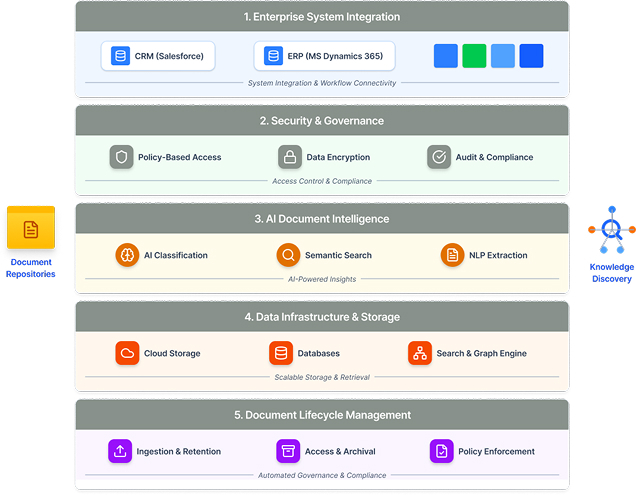
The Solution Architecture

Enterprise Documents Intelligence Architecture

Enterprise Documents Intelligence Architecture

6.1. Enterprise System Integration Layer

The first layer focused on connecting enterprise business systems to the document intelligence platform.

CRM systems (Salesforce)
Automatically provision document workspaces when new client engagements are created.
ERP platforms (Microsoft Dynamics 365)
Synchronize financial metadata and project identifiers with document repositories.
Microsoft 365 ecosystem
Enable seamless document access and collaboration through tools such as Teams, SharePoint, and Outlook.

These integrations ensured that document management became embedded directly into business workflows rather than existing as a separate system.

6.2. Security and Governance Architecture

Given the organization's regulatory requirements, security and governance controls were embedded directly into the document lifecycle.

Policy-based access control (PBAC)
Access permissions determined by role, department, geography, and regulatory classification.

Granular document-level security
Control read, edit, share, and delete permissions for individual files.

Regulatory policy enforcement
Governance aligned with frameworks such as GDPR and financial regulatory requirements.

Comprehensive audit logging
Every document interaction—including access, modification, and deletion—is recorded to support compliance reporting.

These capabilities ensure that sensitive information remains protected while enabling secure collaboration across teams.

6.3. AI-Powered Document Intelligence Layer

Artificial intelligence capabilities were embedded across the document lifecycle to improve document understanding and knowledge discovery.

AI-based document classification
Machine learning models automatically categorize documents by type and business context.

Metadata extraction using natural language processing
Extract key entities such as client names, contract values, and project identifiers.

Semantic search using vector embeddings
Allow employees to locate documents based on meaning and context rather than exact keywords.

Conversational document interaction
Employees can ask natural language questions to retrieve insights from enterprise documents.

These capabilities significantly improve knowledge discovery across large document repositories.

6.4. Data Infrastructure and Storage Architecture

The solution architecture included scalable infrastructure designed to manage enterprise-scale document environments.

  • Cloud object storage for large-scale document repositories
  • Relational databases for metadata and policy management
  • Graph databases to model relationships between documents and users
  • Search indexing systems for high-speed document retrieval
  • Caching layers to improve query performance

This architecture allowed the organization to manage petabyte-scale document repositories while maintaining high performance and governance controls.

6.5. Intelligent Document Lifecycle Management

Document lifecycle management was automated to ensure consistent governance across the enterprise.

  • Document ingestion and classification
  • Metadata enrichment and indexing
  • Secure collaboration and access management
  • Retention enforcement and archival
  • Policy-driven document destruction

Automating these lifecycle stages significantly reduced manual governance effort while improving compliance readiness.

7. Deployment Approach

The organization adopted a phased global rollout strategy to ensure smooth adoption across its international workforce. The deployment process consisted of four phases:

Phase 1: Discovery and Architecture Design

  • Validate business requirements across departments
  • Define metadata taxonomy and governance policies
  • Identify integration dependencies across enterprise systems

Phase 2: Platform Customization and Infrastructure Setup

  • Configure AI models for document classification
  • Establish integrations with enterprise systems
  • Design data migration workflows

Phase 3: Global Deployment

Deployment occurred through regional rollouts:

AmericasEurope, Middle East,
and Africa
Asia-Pacific

This approach ensured compliance with regional regulatory requirements such as data residency laws.

Phase 4: Managed Services and Optimization

Following deployment, the organization transitioned to a managed services model including:

  • 24×7 platform monitoring
  • Performance optimization
  • Security monitoring
  • Feature enhancements

8. Business Impact and Measurable Outcomes

The implementation delivered measurable operational improvements across multiple dimensions.

Faster Document Discovery

Semantic search significantly reduced the time required for employees to locate information across distributed repositories.

According to Deloitte, organizations that deploy AI-powered knowledge discovery tools can reduce information search time by up to 50%.

Reduced Manual Document Processing

AI-driven classification eliminated manual tagging processes. This reduced administrative workload and improved metadata accuracy across document repositories.

Improved Compliance Readiness

Automated retention policies and audit logging improved regulatory reporting and reduced compliance risk.

According to Gartner, organizations with automated governance frameworks reduce compliance risk exposure by up to 60%.

Enhanced Enterprise Collaboration

Secure project workspaces enabled collaboration between internal teams and external stakeholders while maintaining strict governance controls.

This improved knowledge sharing across departments and geographic regions.

By transforming fragmented document repositories into an intelligent knowledge platform, the organization strengthened governance, improved operational efficiency, and unlocked greater value from its enterprise information assets.

9. Unlocking Enterprise Value Through Cognitive Document Intelligence

Cognitive Document Intelligence is no longer a future concept, it is a business imperative. As enterprises scale, the ability to transform documents into real-time, actionable intelligence directly determines speed, efficiency, and profitability. Organizations that make this shift unlock faster execution, lower operational costs, and more informed decision-making, driving measurable productivity gains and stronger ROI while operating with greater agility in an increasingly dynamic landscape.

This is where Kagen PRISM delivers tangible impact. Built to convert fragmented, unstructured content into a unified intelligence layer, it enables enterprises to move from manual, time-intensive processes to real-time, insight-led operations, turning documents into a true strategic asset.

Up to 50%reduction in operational costs by eliminating manual document handling
2–3×faster decision-making with instant, context-aware access to information
Significantproductivity gains across teams by reducing search and processing time
Fastercompliance and audit readiness with built-in governance and traceability

Beyond efficiency, Kagen PRISM enables organizations to scale without linear cost increases, accelerate time-to-market, and respond to opportunities with precision. What was once a fragmented document ecosystem becomes a continuous flow of intelligence, fueling better decisions, stronger performance, and sustained competitive advantage.

In a data-driven economy, the edge will belong to enterprises that move beyond managing documents to monetizing knowledge at scale, and Kagen PRISM is built to power that transformation.

10. About Kagen.ai

Kagen.ai

Kagen.AI represents the next evolution in enterprise transformation, bringing together intelligence, automation, and execution into a unified framework. As organizations navigate growing complexity across data, systems, and customer experiences, it enables a shift from manual processes to intelligent, adaptive operations, helping enterprises move faster, make better decisions, and reduce operational friction.

From a leadership perspective, Kagen.AI empowers decision-makers with real-time visibility and control, enabling a shift from reactive to proactive, insight-driven strategies. It aligns business priorities with execution, fosters innovation at scale, and ensures accountability, so transformation delivers sustained, measurable impact.

At its core, Kagen.AI powers agentic-driven deployment, orchestrating intelligent agents to streamline workflows, automate complex processes, and embed decision-making across the enterprise. This drives greater agility, consistency, and efficiency, while allowing teams to focus on high-value, strategic initiatives.

As enterprises look ahead, Kagen.AI serves as a catalyst for scalable, AI-native growth, accelerating innovation, improving time-to-value, and enabling organizations to build intelligent, self-evolving systems that drive long-term success.

Thank You

Lets Connect