

Conversational AI Voice Agents in Call Centers: Transforming Customer Experience at Scale

AI-powered call centers are rapidly reshaping customer service across industries, and for good reason. Organizations adopting an AI voice agent are experiencing up to 23% annual growth while reducing operational costs by as much as 40%.
Despite handling billions of customer interactions each year, nearly 80% of contact centers still rely on outdated systems. The result? Long wait times, repetitive verification processes, and inefficient call transfers that frustrate both customers and agents.
AI call centers address these challenges by combining speech recognition, large language models, and natural voice synthesis. This enables intelligent AI voice agents & open voice that understand context, respond conversationally, and resolve issues autonomously, without human intervention.
In this section, we explore the technologies behind AI call centers, their business impact, real-world use cases, and key considerations for successful call centre integration using the right AI voice agent platform.
What Are Conversational AI Voice Agents?
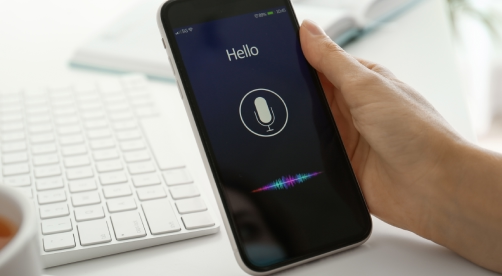
Conversational AI voice agents are intelligent systems designed to interact with humans through natural, human-like voice conversations. Unlike traditional ivr phone systems that rely on rigid menus and predefined responses, these agents understand intent, context, and nuance, enabling fluid, dynamic interactions that feel closer to speaking with a real person.
At their core, conversational AI voice agents combine multiple advanced technologies to interpret speech, process meaning, and generate appropriate responses in real time—forming a robust AI Voice Agent Architecture. They don’t just respond to commands, they engage in meaningful dialogue, adapt to different scenarios, and continuously improve through learning.
What powers conversational AI voice agents?
- Natural Language Processing (NLP): Enables the system to understand user intent, even when phrased differently
- Automatic Speech Recognition (ASR): Converts spoken language into text for processing
- Text-to-Speech (TTS): Delivers responses in a natural, human-like voice
- Machine Learning (ML): Helps the system learn from past interactions and improve over time
- Context Management: Retains conversation history to ensure continuity and relevance
What makes them different from traditional systems?
- Intent-driven, not menu-driven: Users can speak naturally instead of navigating options
- Context-aware conversations: The system remembers previous inputs within the same interaction
- Dynamic responses: Answers are generated based on real-time understanding, not static scripts
- Scalability: Can handle thousands of conversations simultaneously without performance drops
In a call center or customer engagement environment, conversational AI voice agents act as the first line of interaction- handling queries, resolving issues, and even performing complex tasks like scheduling, lead qualification, or transaction support.
Why they matter today
As customer expectations shift toward instant, personalized experiences, businesses need solutions that are both scalable and intelligent. Conversational AI voice agents bridge this gap by delivering:
- Faster response times
- Consistent customer experiences
- Reduced dependency on human agents for repetitive tasks
- Improved operational efficiency
In essence, they transform voice interactions from transactional exchanges into intelligent, engaging conversations, making them a critical component of modern customer experience strategies.
Also read: Guide to Protecting Your Applications Against Modern Software Supply-Chain Threats
Key Use Cases Transforming Customer Service
Adopting AI voice agent services is not just about innovation, it’s about solving real operational challenges. Businesses are increasingly using conversational AI agents for businesses, including AI sales agents, to streamline support, sales, and engagement.
1. Customer Service Automation
A large portion of contact center volume, around 50–60%, comes from repetitive tier-1 queries such as password resets, order tracking, and basic troubleshooting. AI voice agents and automated answering service capabilities can handle these efficiently without compromising quality.
More importantly, these systems can manage multiple intents within a single interaction. For example, if a customer calls about a delayed order and also requests an address update, the voice agent can handle both seamlessly, without restarting the process.
The most effective implementations focus on clearly defined workflows while ensuring smooth escalation paths. When needed, the system transfers the interaction to a human agent along with full context, eliminating repetition and improving experience.
2. Outbound Communications
With AI calling and AI cold calling, businesses can significantly improve outreach efficiency compared to traditional robocalls. AI-powered outbound communication enables:
- Appointment confirmations and reminders
- Delivery updates and coordination
- Payment reminders and collections
- Maintenance scheduling
- Real-time feedback collection
Unlike one-way communication, an artificial intelligence call is interactive. For instance, if a customer wants to reschedule an appointment, the system can instantly check availability and confirm a new slot, powered by AI voice assistants for enterprises.
3. After-Hours Support
Traditional call centers face a trade-off between high staffing costs and limited availability. AI voice agent services for businesses eliminate this challenge by enabling 24/7 support without additional overhead.
The most effective use of AI voice agents focuses on high-impact scenarios where immediate resolution matters- such as emergency requests or urgent travel changes.
Imagine resolving a booking issue at 2 AM through an intelligent AI voice assistant while competitors offer only voicemail. That level of responsiveness creates a strong competitive advantage.
4. Industry-Specific Applications
While general-purpose AI-powered voice assistants deliver value, the most impactful results come from specialized implementations tailored to specific industries.
- Healthcare: Appointment scheduling and patient communication
- Financial Services: Secure authentication and account support
- Retail & E-commerce: Order management and returns
These use cases highlight how conversational AI voice agents can be customized within conversational AI platforms to deliver targeted value. The key is identifying high-impact interaction points rather than attempting to automate everything at once.
Measuring the ROI of Conversational AI
The business value of deploying an AI voice agent platform becomes clear when performance is measured effectively. Organizations using AI voice agent services have reported significant cost reductions along with improved customer satisfaction.
Key Metrics to Track
To evaluate the success of conversational AI agents for businesses, consider the following KPIs:
- Response and resolution time: Faster interactions improve customer experience
- Customer satisfaction (CSAT/NPS): Reflects the effectiveness of customer interaction automation
- Agent workload metrics: Reduced dependency on human agents highlights efficiency gains
Long-Term Business Impact
Beyond immediate savings, AI voice agents contribute to long-term growth:
- Improved operational efficiency: Automation allows teams to focus on strategic tasks
- Lower scaling costs: Expanding AI is more cost-effective than hiring at scale
- Revenue growth: Better experiences drive retention and conversions
With the right AI voice agent agency and platform, businesses can unlock the full potential of conversational AI voice agents and build a scalable, future-ready customer engagement strategy.
Also read- AI Voice Calling Agents in 2026: Are Human Sales Calls Becoming Obsolete?
What Sets Kagen VOICE Apart
Kagen VOICE goes beyond traditional AI voice solutions by delivering a truly intelligent, scalable, and enterprise-ready experience. While many platforms focus on basic automation, Kagen VOICE is built to handle real-world , context, and flexibility.
Why Kagen VOICE stands out:
- True conversational intelligence: Moves beyond scripted responses to understand intent and context, enabling natural, human-like interactions
- Omnichannel by design: Seamlessly connects voice, SMS, and chat while maintaining conversation continuity
- Enterprise scalability: Handles high volumes of interactions without compromising performance or experience
- Fast and flexible deployment: Pre-built capabilities allow quicker implementation with minimal complexity
- Deep integrations: Easily connects with CRM, APIs, and backend systems for personalized call center integrators, data-driven interactions
- Continuous learning: Improves over time with every interaction, delivering smarter and more accurate responses
Kagen VOICE is not just an automation tool—it’s a complete conversational AI solution designed to elevate customer engagement at scale, powered by a leading voice AI API for seamless CRM connectivity.
Conclusion
Conversational AI voice agents are transforming call centers by replacing fragmented, manual processes with seamless, intelligent interactions. They enable faster resolutions, 24/7 availability, and consistent customer experiences, while significantly reducing operational costs and agent workload.
By automating repetitive tasks and delivering context-aware conversations, businesses can improve both efficiency and customer satisfaction at scale. More importantly, this shift allows human agents to focus on complex, high-value interactions, creating a more effective support ecosystem.
As customer expectations continue to rise, adopting AI-driven solutions like Kagen VOICE is no longer optional, it’s a strategic move to stay competitive and deliver superior customer experiences.


%20and%20Why%20It%20Will%20Replace%20Traditional%20SDLC/What%20Is%20Agentic-Driven%20Delivery%20(ADD)%20and%20Why%20It%20Will%20Replace%20Traditional%20SDLC%202%20thum.avif)